
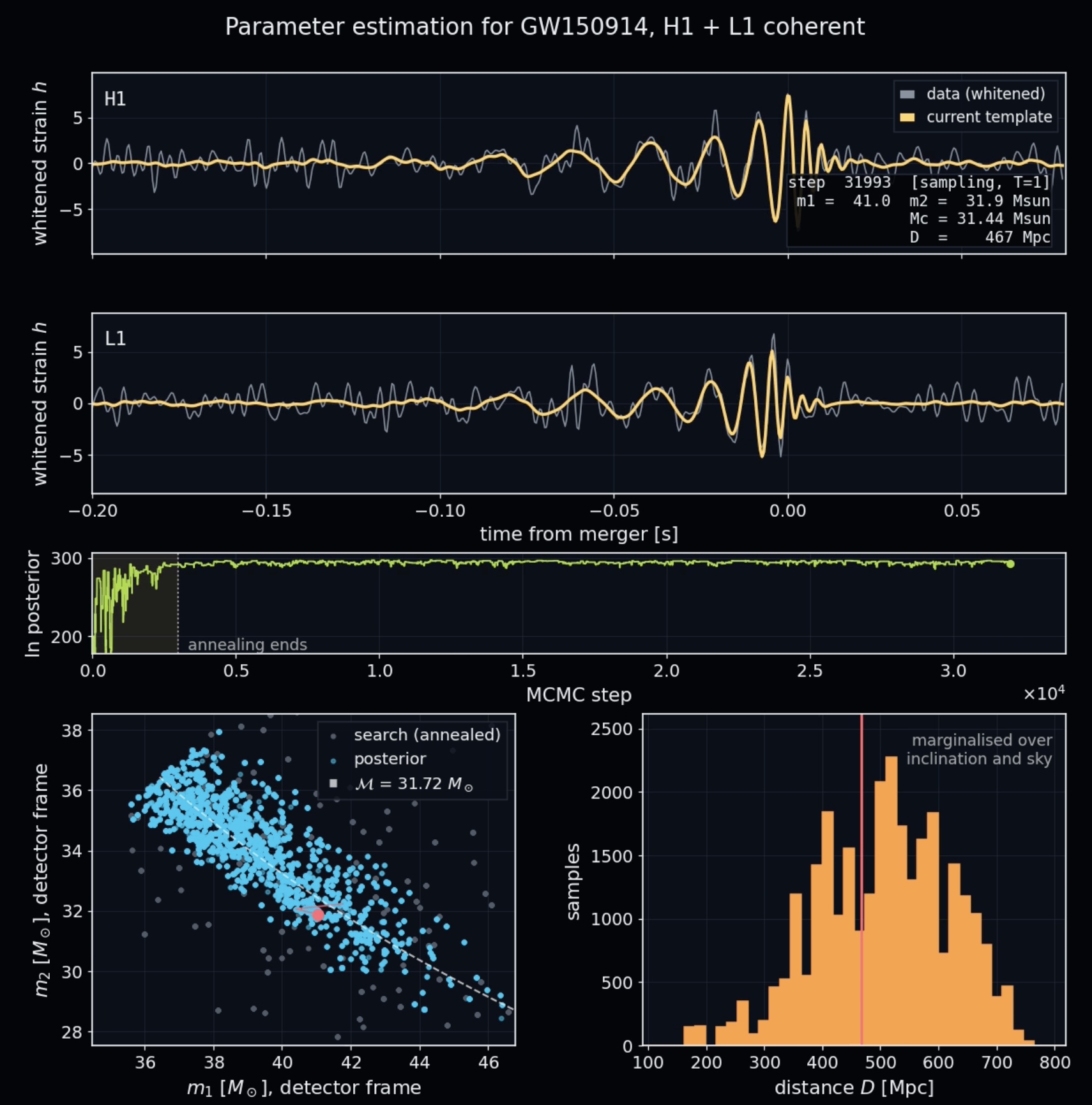
You have detected a gravitational-wave signal: congratulations! But the hard work has just started!
How do you figure out what was the source of the signal? Was it from two black holes or two neutron stars? How far? Where in the sky?
Enter the parameter estimation algorithms. The idea is simple: compare the measured signal with a large bank of template waveforms, each one with slightly different parameters like mass, orientation, distance, sky position, ellipticity, etc.
For each of those templates, estimate the probability that it matches the measured signal in presence of noise: this is the probability of measuring that particular signal given the source parameters.
However, what we need is the probability distribution of the source properties given the measured data: to obtain this we use Bayes probability theorem, and a probabilistic sampling based on Markov Chain Monte Carlo (MCMC) algorithms.
Those are computationally heavy techniques to draw samples from the distribution of the parameters given the measured data, obtained evaluating numerical integrals via random sampling.
In other words, you pick random values for all the parameters, and check how close the prediction is to the actual measurement. If it’s close enough, you keep it, if it’s too different, you get rid of it. Eventually you’ll end up with a lot of samples in parameter space, but there will be more close to the real source parameters. Then you can look at the distribution of the samples, and compute the probability and uncertainty in the estimated parameters.
It takes a lot of computing power, but it’s the best way to have an accurate estimate of what generated the gravitational-wave signal, and maybe even more important to know the uncertainty in all parameters.
The animation shows how a simple Markov Chain Monte Carlo parameter estimation algorithm would attack the first gravitational-wave detection – GW150914 – when trying to estimate only a few parameters (masses, distance, inclination) and using simplified waveform models. Initially the algorithm explores many different parameters, to find those with the highest likelihood and tune it to produce the final probability distribution of the best estimates of the parameters. The simplified model and reduced number of parameters explains why the estimations aren’t quite correct: we had to use a full model with more than ten parameters in the real analysis.
I post every week simple explanations of the science and engineering behind the discovery and detection of gravitational waves. Follow and connect!
Leave a Reply