
You’re trying to measure WHAT?
Gravitational waves, and they make very VERY small signals, moving LIGO’s mirrors by less than one thousandths of the size of a proton! The problem is, the ground is continuously shaking by millions of millions times more than that!
So LIGO’s mirrors cannot be just sitting on the ground. We need to figure out a way to make them move less. We achieve that by using two cascaded approaches: active seismic isolation and passive suspensions.
We talked about the active seismic isolation part already, so let’s focus on the passive suspension today. The active internal seismic isolation table (ISI) can reduce the motion to around a picometer, still many many orders of magnitude more than what’s needed to detect gravitational waves.
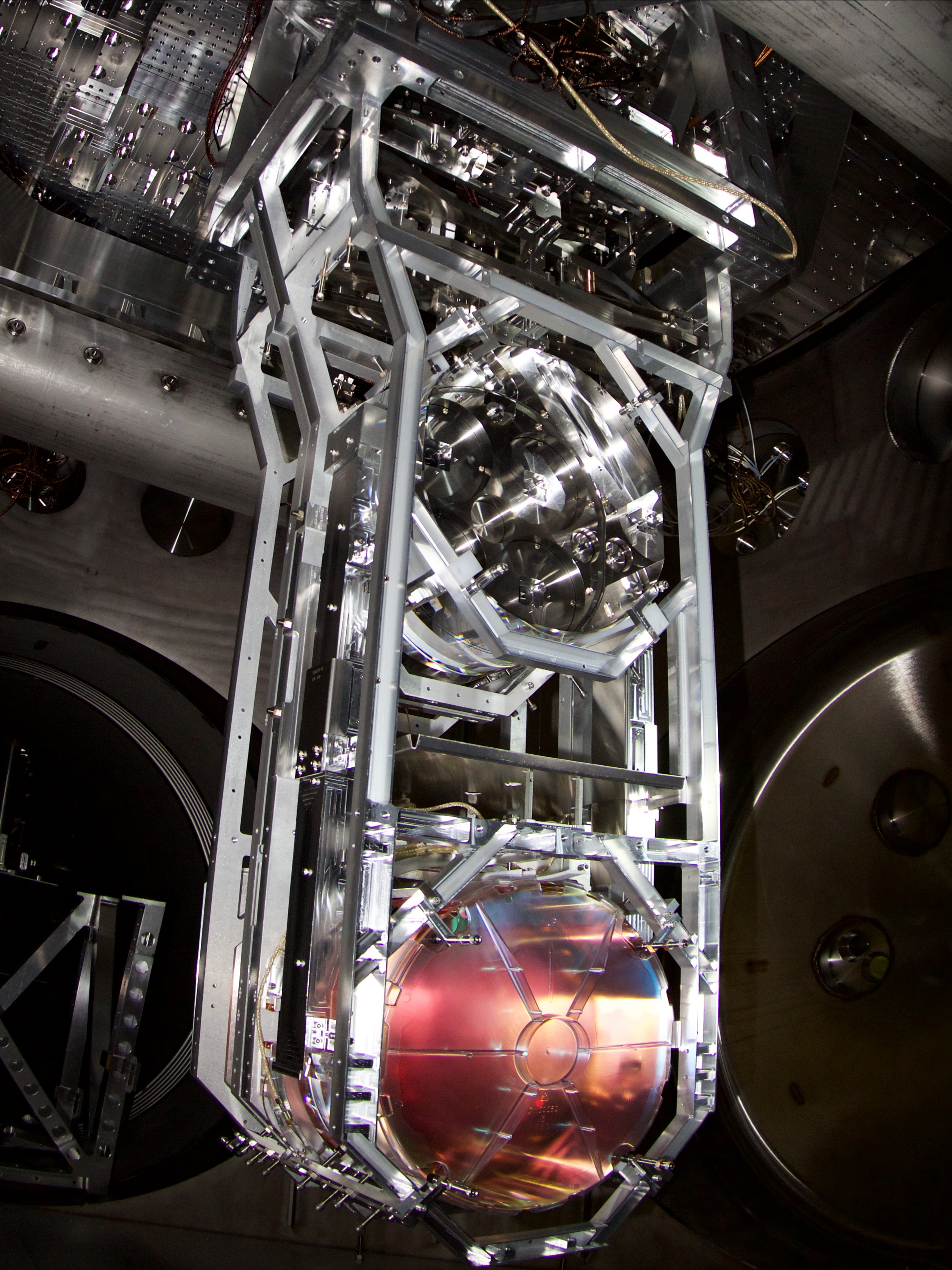
To close the gap, we use passive suspension systems. The idea is simple: you suspend an object – our mirror – from a string to make a pendulum. The motion of the suspension point at the top is transmitted to the suspended object at the bottom in a way that depends on the frequency: at low frequency the suspended object moves like the top, but at higher frequencies, above the pendulum’s natural resonance, the object at the bottom moves much less.
In LIGO we stack four pendulum stages to obtain all the isolation we need for our mirrors. This works in combination with the active seismic isolation to make sure that LIGO’s mirrors move much less than 0.00000000000000000001 m at all frequencies above about 10 Hz. That’s what we need so that the very small effect due to gravitational waves isn’t lost in the residual motion due to the ground continuous vibrations.
I post every week simple explanations of the science and engineering behind the discovery and detection of gravitational waves. Follow and connect!
Leave a Reply